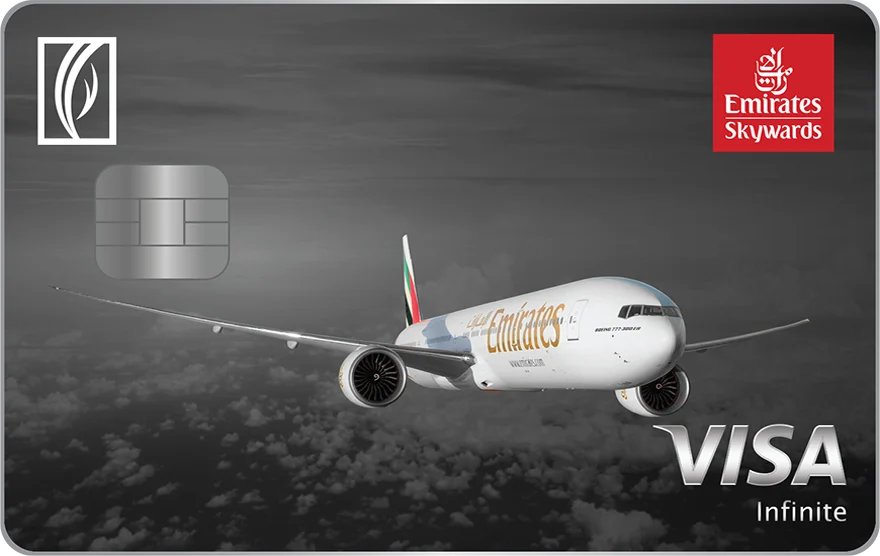
If you have just landed in the UAE and a colleague has told you to “just get the Emirates one”, pause. UAE credit card eligibility is stricter than UK or US issuance, the products are priced higher, and the right card for you depends on three things: your monthly salary, where your salary is transferred, and whether you fly Emirates or Etihad more than twice a year.
This guide is part of the DubaiPoints Expat Starter track.
How to read a UAE credit card listing
Every card on this site has the same six fields up top, in this order:
- Annual fee. The yearly fee charged from year two onward. The first year is usually waived. AED 1,000–3,000 is normal for a premium card.
- FX fee. Charged on every non-AED transaction. Most cards in our database charge 1.99–2.99%, a few up to 3.7%, and two charge nothing; below 2% is good.
- Minimum salary. Issuers publish eligibility thresholds and may require evidence of salary. The bank verifies via the salary certificate or salary slip — you cannot understate or overstate this number.
- Salary transfer status. Either required (the card is only available if your salary is transferred to that bank) or not required. Some premium cards demand it (the Emirates NBD Etihad Guest Elevate and Visa Infinite and FAB Elite among them); many, including the ENBD Skywards Infinite and FAB Etihad Guest Infinite, do not.
- Welcome bonus. Usually expressed in miles or cashback. UAE welcome bonuses are smaller than US equivalents — the ENBD Skywards Signature offers up to 40,000 Skywards Miles and the Skywards Infinite up to 100,000 — and the qualifying windows are typically 60–90 days.
- Best earn rate. The category with the highest multiplier. A “2.5× on dining” card earns more than a “2× on dining” card on each AED of dining spend, but the underlying currency may differ.
What eligibility actually means
A UAE credit card application requires:
- A valid UAE residency visa. Tourists and visit-visa holders cannot hold UAE credit cards.
- An Emirates ID. No EID, no card.
- A salary certificate or trade licence, no older than 30 days, showing your monthly income.
- Three months of bank statements showing the salary actually being paid.
- A security cheque (yes, paper) for the credit limit, undated and signed.
- AECB credit bureau consent so the bank can pull your UAE credit history.
If you do not yet have an Emirates ID, you cannot apply. If you have been in the country for less than three months, your bank statements will not yet show enough salary history to support a premium card.
The three archetypes
Pick the archetype that matches your spend pattern. Then read the individual card reviews on this site to find the specific card.
Archetype 1: the cashback workhorse
For an expat earning AED 8,000–25,000 per month who does not fly Emirates or Etihad regularly. The Mashreq Cashback, Citi Cash Back and ADCB 365 Cashback all fit this slot (see the entry-level roundup). Look for:
- 1–2% flat cashback on all spend (not a category-restricted multiplier).
- A monthly cashback cap you actually approach (a 5% card capped at AED 200/month is mostly a 5% card on AED 4,000 of spend, then 0%).
- AED 0 first-year fee and a fee of AED 600 or less from year two.
- No salary-transfer requirement so you can keep your existing bank.
Archetype 2: the airmiles flagship
For an expat who flies Emirates or Etihad more than twice a year and earns at least AED 25,000 per month. Direct-earning cards (Skywards Infinite, FAB Etihad Guest Infinite) beat transferable points cards in the UAE because the transfer ratios are generally poor. Look for:
- Direct earning of the airline currency you actually fly on. If you fly Emirates, prioritise Skywards earning over a “transferable points” card that nominally lets you transfer to Skywards 1:1.
- 2–2.5× on dining and travel; 1× on everything else is acceptable.
- Year-one fee waiver large enough to recover the welcome bonus runway.
- A clear path to recovering the year-two annual fee — typically a single long-haul economy-to-business-class upgrade pays for two years of fees, but only if the redemption availability holds.
Archetype 3: the no-salary-transfer all-rounder
For an expat whose salary is transferred to a bank with a weak card lineup, or who wants to keep salary-transfer status for a future move. Cards from FAB, Mashreq, and Citi UAE often allow application without salary transfer. Trade-off: the welcome bonus and earn rate may be lower than a salary-transfer-required equivalent from the same bank.
What about the welcome bonus?
UAE welcome bonuses are smaller than US ones, and the spend hurdles are lower. A typical premium-card welcome offer is “40,000 miles for AED 25,000 spend in 90 days.” If you have just signed a Dubai apartment lease, you will hit that on the first month’s rent payment. So:
- The welcome bonus is often the single best AED-per-mile earning rate you will ever get from the card. Time the application so a large one-off expense — rent, school fees, a flight — falls inside the qualifying window.
- Do not chase the welcome bonus on a card you would not otherwise want. The annual fee from year two will cost more than the bonus value if you do not actually use the card.
What to do this week
- Open the DubaiPoints comparison table, sorted by minimum salary, and note every card that lists a minimum salary at or below your monthly salary. Those are the only cards you can actually apply for.
- Of those, identify which archetype above fits your spend pattern.
- Read the full review of two or three cards in that archetype before applying. Not every premium card is worth its annual fee, and our editorial verdict is on every review page.